

Bespoke booking systems vs Calendly or TinyCal

If you run a business that takes bookings, whether that’s appointments, classes, rooms or resources, there’s a good chance you’re using something like Calendly or TinyCal right now. Both are perfectly capable tools, and for many businesses they’re exactly the right solution.
But there comes a point where the question isn’t simply whether your booking software works. It’s whether you’re still getting the best fit for the way your business actually operates.
That’s where a bespoke booking system can start to make sense.
WHY SO MANY BUSINESSES START WITH A SUBSCRIPTION
Tools like Calendly and TinyCal are attractive for a good reason. They’re quick to set up, relatively inexpensive, and you don’t need to commission software development just to start taking bookings online.
For a consultant, freelancer or small business taking straightforward one-to-one appointments, that can be more than enough.
The trade-off is that you’re using a platform designed to work for thousands of different businesses. You’re paying for access to that platform, rather than owning software designed around your particular operation.
Over time, the subscription itself may become significant, particularly if you need team scheduling, more advanced availability rules, payment collection, branding or other paid features. But the bigger question isn’t necessarily how much you’re spending on the subscription. It’s whether the system is still the right fit for your business.
A GENERIC TOOL TRYING TO FIT YOUR SPECIFIC BUSINESS
Calendly and TinyCal are designed to handle common booking scenarios across a wide range of businesses. That’s one of their biggest strengths.
But it’s also where their limitations can appear.
Your business might have capacity rules that don’t quite fit the standard options. You might need different availability for different resources, staggered time slots, complex booking rules, specific cancellation conditions or a booking process that needs to interact with other parts of your website.
You can often find a workaround. But if you’re continually adapting the way your business works to fit the software, it may be worth considering the opposite approach: software that is built around the way your business already works.
YOUR BOOKING EXPERIENCE SHOULD FEEL LIKE YOUR BUSINESS
There’s another consideration that’s easy to overlook: the customer experience.
When customers book through a third-party platform, you’re working within that platform’s interface, booking flow and limitations. Even when the experience is branded to some extent, the underlying system isn’t really yours.
A bespoke booking system can make the entire journey feel like part of your own website and brand, from checking availability through to payment and confirmation.
More importantly, the booking process can be designed around what your customers actually need to do, rather than around the options a generic booking platform happens to provide.
WHAT A BESPOKE BOOKING SYSTEM ACTUALLY GIVES YOU
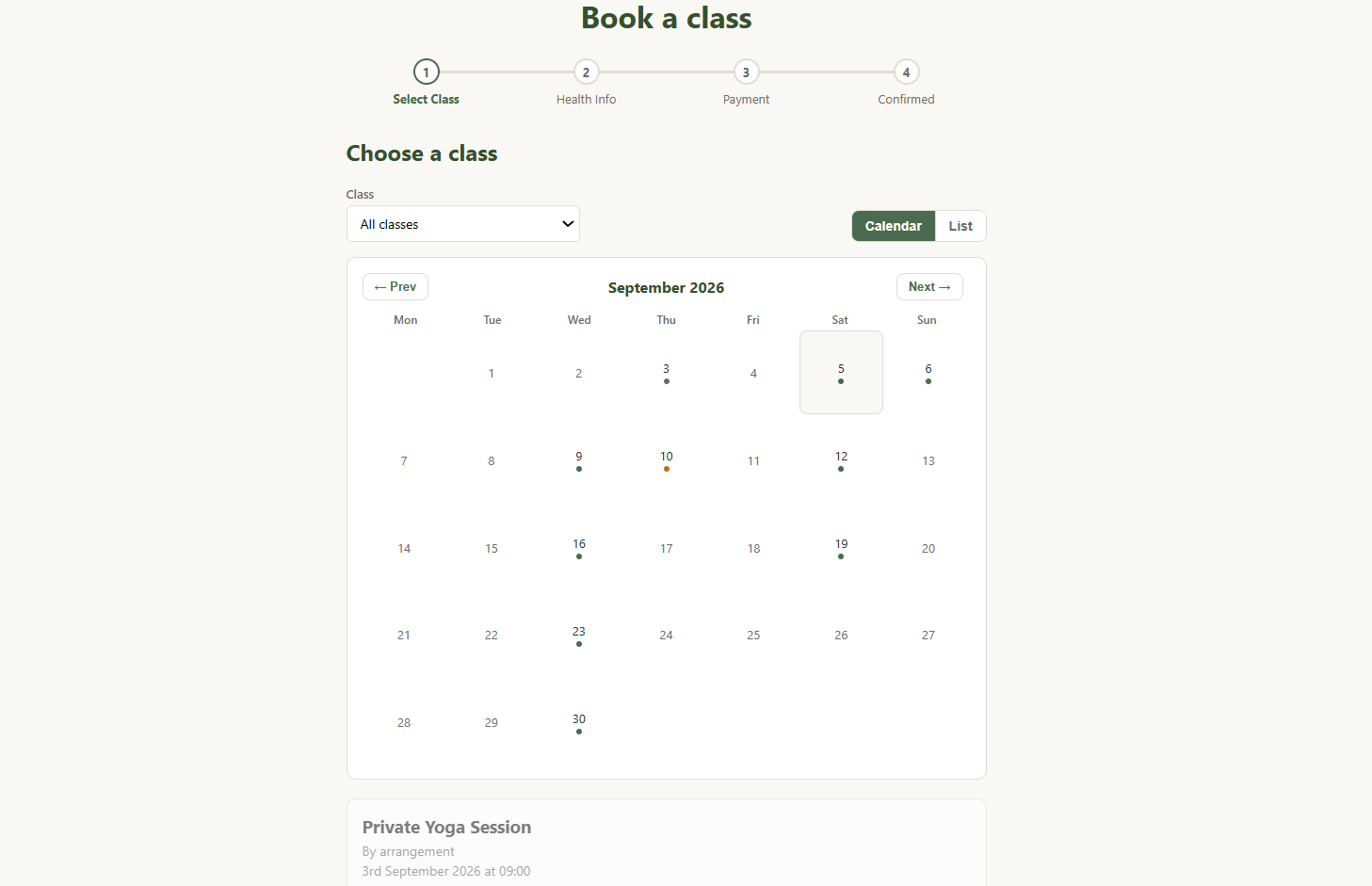
BUILT AROUND YOUR BUSINESS
A bespoke booking system is developed specifically around your requirements rather than asking your business to fit a predefined model.
That could mean different booking rules for different services, specific capacity limits, resource availability, custom pricing, membership rules, recurring bookings or integrations with other systems you already use.
The point isn’t simply to have a booking calendar that looks different. It’s to have a booking system that understands how your business operates.
REAL CAPACITY LIMITS, NOT A GENERIC APPROXIMATION
If you run classes, manage rooms, hire equipment or allocate staff, availability isn’t always as simple as “free” or “busy”.
A bespoke system can be designed around your actual capacity rules: maximum numbers per session, resource-specific availability, staggered start times, booking combinations or other constraints that are particular to your business.
Instead of finding a workaround for an unusual requirement, the system can be designed to support it from the beginning.
YOUR WEBSITE, YOUR CUSTOMER JOURNEY
Payments can be handled securely through services such as Stripe while keeping the booking experience within your own website and brand.
Customers can browse availability, select what they need, enter their details, make a payment and receive confirmation as part of a booking journey designed specifically for your business.
The payment processor still handles the underlying transaction securely, but the customer experience doesn’t have to feel like they’ve left your website to use somebody else’s booking system.
SOFTWARE YOU OWN, WITH SUPPORT WHEN YOU NEED IT
With a bespoke system, you’re investing in software developed specifically for your business rather than taking out a licence to use a generic platform.
That doesn’t mean there are never ongoing costs. Hosting, maintenance, security updates, monitoring and future development still need to be considered.
The difference is that you’re maintaining a system you own and control, rather than being dependent on the pricing, feature roadmap and limitations of a third-party booking platform.
WHEN A SUBSCRIPTION TOOL STILL MAKES SENSE
It’s important to say that bespoke isn’t automatically better.
If you’re a consultant or freelancer taking straightforward one-to-one bookings, testing whether online scheduling suits your business, or your requirements are simple and unlikely to change, Calendly or TinyCal can be a perfectly sensible choice.
They’re quick, proven and cost-effective for the right kind of booking process.
There’s no reason to replace something that already does exactly what you need.
WHEN IT’S WORTH CONSIDERING BESPOKE
The decision starts to change when your booking system becomes a core part of how your business operates.
Perhaps you’ve been using a subscription platform for years and have accumulated workarounds. Perhaps your staff spend time managing bookings manually because the system can’t quite handle your rules. Perhaps customers are being sent through a booking process that doesn’t really match your website or brand.
Or perhaps you need your booking system to connect with other parts of the business, such as customer accounts, memberships, invoicing, reporting, CRM systems, staff allocation or resource management.
At that point, the question isn’t simply whether a bespoke system costs more than a subscription.
It’s whether the additional flexibility, control and efficiency justify the investment.
For some businesses, the answer will still be no. For others, it can be a much better long-term fit.
THE REAL VALUE OF OWNING YOUR BOOKING SYSTEM
The strongest reason to go bespoke isn’t simply to stop paying a monthly subscription.
It’s to stop forcing your business’s processes into somebody else’s booking model.
A bespoke system can become part of your wider business infrastructure, connecting bookings with the other systems and processes you already rely on.
And because it’s built specifically for you, it can evolve as your business changes rather than waiting for a third-party platform to introduce the feature you need.
OWNING YOUR OWN BOOKING SYSTEM
We’ve been developing bespoke booking systems for businesses that have outgrown generic booking tools and need something built around the way they actually operate.
That might mean real capacity limits, custom availability, secure payment handling, integrations with existing systems, or simply a booking journey that feels like a natural part of your own website.
We don’t think every business needs a bespoke booking system. If Calendly or TinyCal does everything you need, keep using it.
But if you’re constantly working around your booking software, paying for features you don’t really need, or wishing the system worked differently, it might be time to look at what’s possible.
Tired of adapting your business to fit your booking software? Let’s have a conversation.